You approved the ad budget. The campaign dashboard shows clicks, impressions and a reasonable cost per click. Yet the sales team says the leads are thin, late or simply not there. The usual reaction is to blame the ads, change the agency or cut spend.
In most Indian B2B accounts we review, ad spend is not where the money leaks. The leak sits after the click: on a weak landing page, in a form that quietly fails, in a WhatsApp chat nobody logs, or in an inbox that sales never checks. Until that path is fixed, more clicks only means more wasted enquiries.
This guide is for MDs, founders and marketing heads running lead generation campaigns for a B2B business in India. It explains where leads usually escape, what a proper landing page and CRM setup looks like, and how we at Hyrrokkin approach it before scaling any campaign.
Ad spend is rarely the real leak
A campaign has three jobs: bring the right people, convince them to raise their hand, and get that raised hand to a salesperson fast. Most reporting only measures the first job. Clicks, reach and cost per click say nothing about whether a serious buyer actually reached your team.
When the second and third jobs are broken, the numbers mislead you. The ads look expensive because the conversion path behind them is losing people. Cutting budget then makes things worse, because the good traffic you were paying for disappears along with the bad.
So the first question is not “how do we get more clicks?” It is “what happens to a buyer between the click and the first sales call?”
Where Indian B2B websites usually leak leads
The same patterns appear again and again when we audit lead paths for established businesses. None of these need a hacker or a big failure. They are quiet, everyday gaps.
1. The enquiry path breaks where it matters
- An “Apply”, “Book a demo” or “Get a quote” button that opens a blank page or a server error.
- A browser warning such as “Your connection is not private” on the very page the ad points to.
- A contact form that shows a success message but never actually delivers the email.
- A phone number or WhatsApp link that is outdated, mistyped or goes to someone who left the company.
A buyer who hits any of these rarely tries again. They go back to search and click the next supplier.
2. Traffic arrives with no reliable capture
- Ads that send people to the homepage instead of a page built for that offer.
- WhatsApp as the only contact option, with no form and no record of who came from which campaign.
- No CRM, so enquiries live in personal inboxes, phones and spreadsheets.
- No tracking that ties a lead back to the campaign, keyword or ad that produced it.
Without capture, you cannot tell a good campaign from a bad one. Every decision becomes a guess.
3. Marketing and sales are out of sync
- Leads reach sales hours or days later, when the buyer has already spoken to a competitor.
- Nobody owns follow up, so enquiries sit untouched.
- Sales says “these leads are junk” and marketing says “sales does not call back”, and neither side has data.
This is the most expensive leak, because it makes a working campaign look like a failed one.
What a lead ready landing page needs
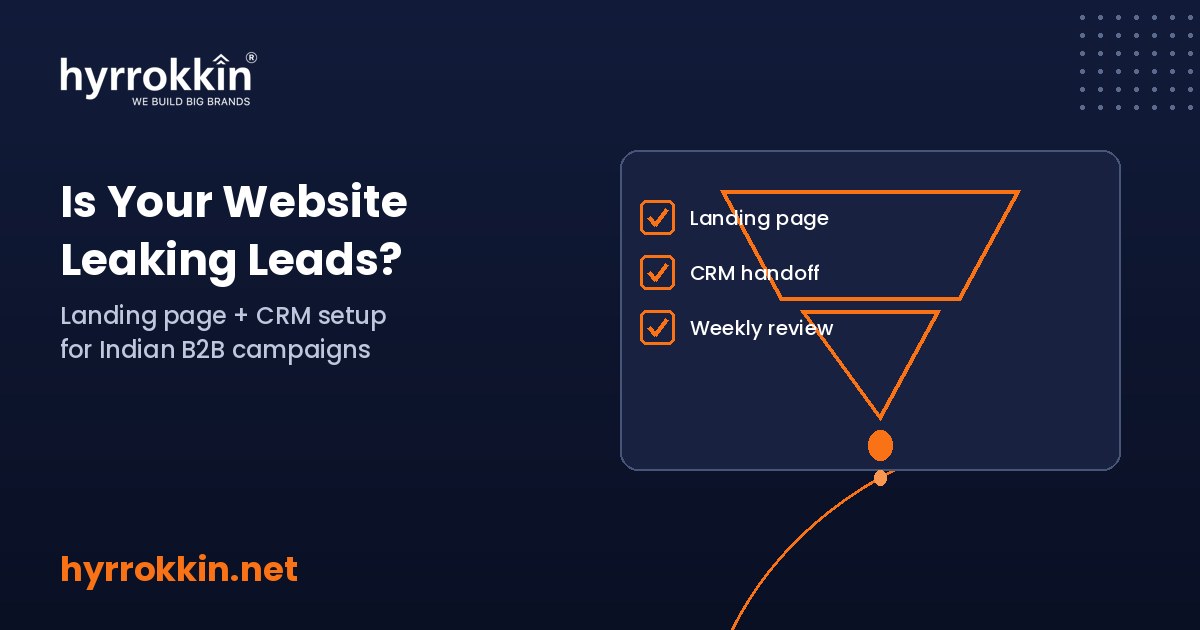
A landing page for a B2B campaign is not a brochure. It has one job: turn a qualified visitor into a named enquiry. In our experience, a page that does this well usually has:
- One clear offer that matches the ad the visitor clicked, in the same words.
- A short, working form that asks only what sales genuinely needs to qualify the lead.
- Trust signals near the form, such as client names you are allowed to show, certifications and real contact details.
- A visible alternative, such as a click to call or WhatsApp button, that is also tracked.
- Fast loading on mobile, because many Indian B2B buyers first see your ad on a phone.
- HTTPS that works everywhere, with no mixed content or certificate warnings.
- A thank you page that confirms the next step and fires conversion tracking.
If your current website cannot support pages like this, or every change needs a developer and a week of waiting, the site itself has become the bottleneck. In that case, fixing the platform through our website modernisation service may come before any campaign work.
What a proper CRM handoff looks like
A good landing page only solves half the problem. The other half is making sure every enquiry reaches the right person, quickly, with context. A sound setup usually covers:
- Every capture point feeds one place. Forms, landing pages, call buttons and WhatsApp enquiries all land in the CRM, not in scattered inboxes.
- Source tracking travels with the lead. Campaign, ad group and keyword details are stored with each record, so you know what produced it.
- Instant alerts to the owner. The assigned salesperson is notified the moment a lead arrives, by email, app or WhatsApp.
- Clear stages. New, contacted, qualified, proposal, won, lost. Simple enough that the team actually updates it.
- A rule for follow up time. Agreed internally, visible in the CRM, and reviewed.
- Lost reasons. When a lead does not convert, the reason is recorded so marketing can adjust targeting.
The tool matters less than the discipline. A simple CRM that the team uses daily beats an expensive one nobody opens.
Why the weekly lead and sales review matters
Most lead generation engagements stop at reporting clicks and form fills. The real improvement comes from putting marketing and sales data in the same room every week.
In a weekly review we look at questions like:
- Which campaigns produced leads that sales actually qualified?
- How fast was each lead contacted, and what happened next?
- Which landing pages convert, and which lose people at the form?
- What lost reasons keep repeating, and what does that say about targeting or messaging?
This is how budget moves from “looks busy” to “produces meetings”. It is also how the arguments between marketing and sales stop, because both sides see the same numbers.
How Hyrrokkin approaches lead generation campaigns
We do not start by asking for a bigger ad budget. We start by checking whether your business is ready to receive leads. Our approach combines three things:
Diagnose capture first
We walk the full path a buyer takes, from the ad or search result to the moment a salesperson calls them. We test forms, links, call buttons, WhatsApp routes, tracking and the CRM. Every broken or untracked step is listed and prioritised.
Fix the landing page and routing
Next, we build or repair focused landing pages for each offer and connect every capture point to your CRM with source tracking and alerts. Where the site cannot support this, we will say so plainly and recommend modernising the website first.
Then scale ads, with weekly lead and sales reviews
Only once leads are captured and routed properly do we push spend. Ad management, ongoing landing page optimisation and a weekly lead and sales review run together, so every rupee is judged by qualified conversations, not clicks.
Signs your website is leaking leads right now
Run through this quick checklist. If you answer “no” or “not sure” to two or more, it is worth a conversation.
- Do your ads point to a page built for that specific offer?
- Have you submitted your own form in the last month and confirmed someone received it?
- Does every page load on mobile without a security warning?
- Can you see which campaign produced each lead?
- Does sales get alerted within minutes of a new enquiry?
- Do marketing and sales review the same lead data every week?
Frequently asked questions
We already run Google and Meta ads. Why would the landing page matter more than the ads?
Because ads can only deliver a visitor. If the page or the handoff fails, even well targeted ads produce few sales conversations. Fixing capture usually makes the existing spend work harder before you add more.
Do we need an expensive CRM?
Not necessarily. What matters is that every enquiry lands in one place, carries its source, and is followed up on time. We help you pick and set up something your team will actually use.
Will you share pricing on the website?
We discuss scope and fees on a call, after we understand your current setup and goals. That way the proposal reflects what your business needs, not a generic package.
What if our website itself is the problem?
Then we will tell you. Sometimes the right first step is a website rebuild or upgrade, which we handle through our website modernisation service.
Stop paying for leads you never see
If your campaigns look busy but your pipeline does not, the leak is probably between the click and the call. Let us map it with you.
Book an Unlock Growth meeting and we will walk through your landing pages, forms, CRM and lead flow, then show you where enquiries are escaping and what to fix first.