VAPT & Vulnerability Remediation - Hyrrokkin
Core Capabilities

What What We Cover

Hyrrokkin combines application security testing with development expertise to help organisations move from finding vulnerabilities to fixing them; whether the findings originate from our assessment or a third-party VAPT report.

#01

VAPT

Identify security weaknesses across supported websites, web applications and APIs through structured vulnerability assessment and security testing.

Our VAPT scope can include

  • Website & Web Application Security Testing
  • API Security Testing
  • Authentication Testing
  • Authorisation & Access-Control Testing
  • Session Management Testing
  • Input Validation Testing
  • Business Logic Testing
  • Security Misconfiguration Review
  • Sensitive Data Exposure Review
  • File Upload Security Testing
  • API Authentication & Authorisation Review
  • Dependency / Component Vulnerability Review
  • Common Web Vulnerability Testing
  • OWASP-aligned Testing
  • Risk Classification
  • Technical Findings & Recommendations
#02

VAPT Remediation

Already have a VAPT report? Hyrrokkin can work with findings produced by your auditor, cybersecurity provider, enterprise customer or internal security team.

We cover:

  • Third-Party VAPT Report Review
  • Finding Validation
  • Technical Impact Analysis
  • Root-Cause Identification
  • Vulnerability Prioritisation
  • Application Code Fixes
  • API Security Fixes
  • Authentication & Access-Control Fixes
  • Security Configuration Fixes
  • Dependency Remediation
  • Security Header Remediation
  • Developer-Level Resolution
  • Regression Testing
  • Evidence Preparation
  • Re-testing Support
  • Auditor / Security Team Clarification Support
#03

Vulnerability Management

Security weaknesses do not stop appearing after one VAPT. Hyrrokkin helps organisations establish a structured process for tracking and resolving identified vulnerabilities.

We cover:

  • Vulnerability Tracking
  • Severity Classification
  • Remediation Prioritisation
  • Finding Ownership
  • Remediation Status Tracking
  • Open / Closed / Accepted Risk Status
  • Target Resolution Timelines
  • Technical Evidence Management
  • Re-test Tracking
  • Recurring Vulnerability Review
  • Dependency Vulnerability Tracking
  • Historical Finding Records

How We Assess, Validate and Resolve Vulnerabilities

01
Scope

Define the application, URLs, APIs, environments, authentication requirements and agreed testing boundaries.

02
Discover

Understand the application's technology, functionality, endpoints, roles and potential attack surface.

03
Assess

Perform appropriate automated and manual security testing against the agreed scope.

04
Validate

Review potential findings to understand technical relevance and reduce unnecessary false positives.

05
Prioritise

Classify findings based on severity, exploitability and potential business impact.

06
Report

Provide clear technical findings with affected components, risk information and recommended remediation.

07
Remediate

Where remediation is included, our engineering team addresses applicable code, configuration or application weaknesses.

08
Re-Test

Resolved findings can be re-tested to verify that remediation has addressed the identified issue without introducing unintended problems.

Our Testing Approach

We Look Beyond Automated Scan Results.

Automated scanners are useful for identifying potential weaknesses, but application security also requires understanding authentication, authorisation, workflows, APIs and application behaviour. Our assessment approach combines appropriate tools with technical validation and manual analysis based on the agreed scope.


Authentication
01
Authentication
  • Login
  • Password Controls
  • Sessions
  • Tokens
  • MFA
  • Account Recovery
Authorisation
02
Authorisation
  • Roles
  • Permissions
  • Privilege Boundaries
  • Object-Level Access
Input & Data
03
Input & Data
  • Validation
  • Injection Risks
  • File Upload
  • Data Exposure
APIs
04
APIs
  • Authentication
  • Authorisation
  • Tokens
  • Endpoints
  • Input Handling
  • Rate Controls
Application Logic
05
Application Logic
  • Workflow Manipulation
  • Business Rules
  • Access Paths
  • Abuse Cases
Configuration
06
Configuration
  • Headers
  • Error Exposure
  • Debug Settings
  • Sensitive Files
  • Deployment Configuration
Icon

Our goal is not just to find vulnerabilities, but to help you understand, prioritise and fix what truly matters.

Targeted Testing
Targeted Testing

Focus on real risks, not just scanner findings.

Technical Validation

Manual analysis to remove false positives.

Risk Prioritisation
Risk Prioritisation

Focus on impact, not just counts.

Actionable Results
Actionable Results

Clear findings with practical guidance.

WHY HYRROKKIN?

Security Testing Meets Engineering Capability.

Finding a vulnerability requires security knowledge. Fixing it correctly often requires understanding the application's architecture, source code, APIs, database and business logic. Hyrrokkin brings both disciplines together.

Security Testing

Identify and validate weaknesses across supported applications and APIs.

Developer-Level Remediation

Address the underlying code or configuration responsible for the vulnerability.

Root-Cause Focus

Go beyond symptoms to understand why the weakness exists.

Controlled Changes

Implement fixes carefully to reduce unintended impact on application functionality.

Re-Testing

Verify applicable remediated findings after technical resolution.

Clear Tracking

Maintain visibility of findings, severity, remediation status and verification.

From one-time testing to continuous improvement

Vulnerabilities Need Ownership Until Closure.

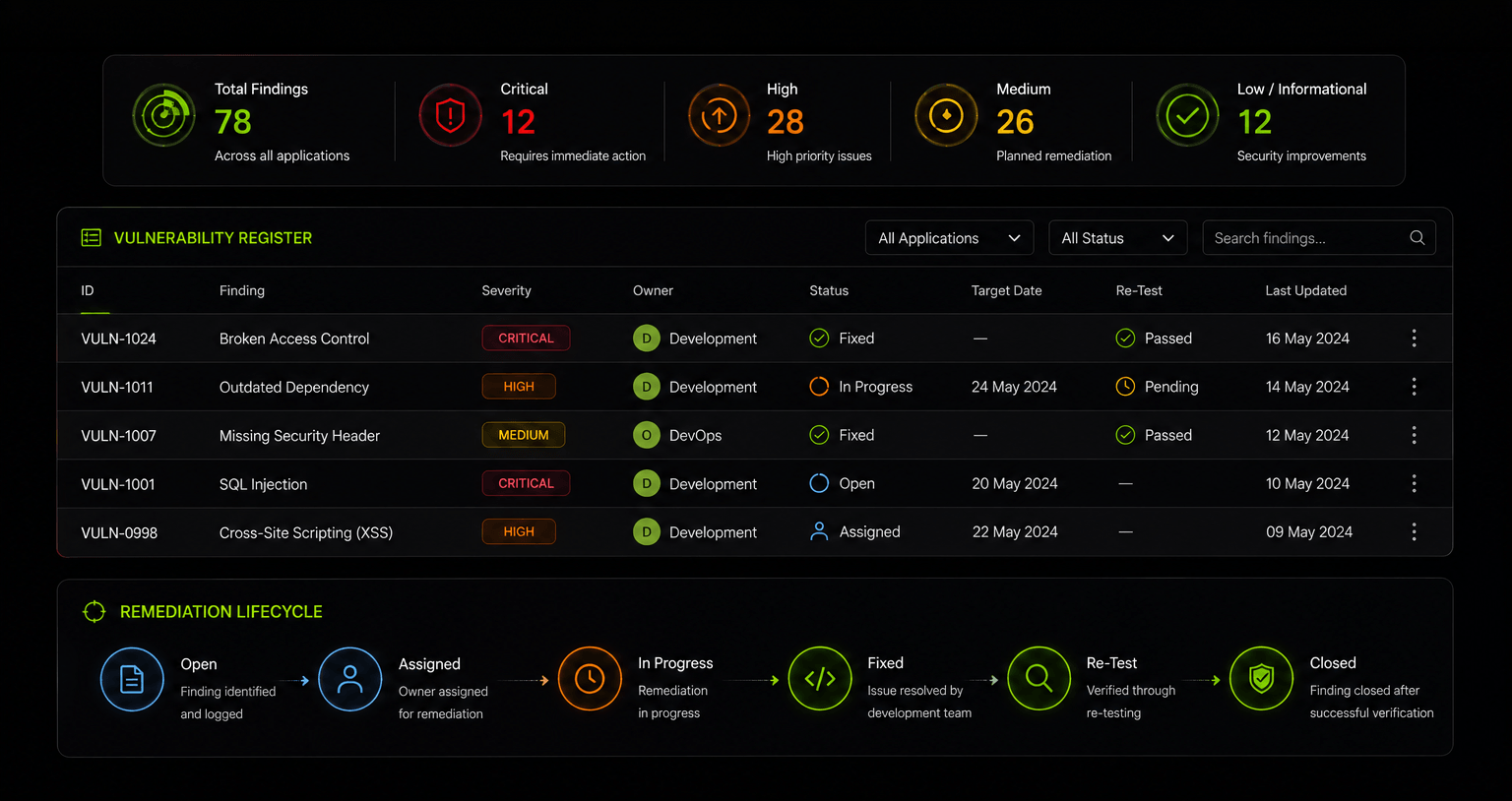
For organisations managing multiple findings or recurring assessments, Hyrrokkin can help maintain a structured vulnerability register.
VAPT
FAQ

Frequently Asked Questions

Everything you need to know about our vulnerability assessment, remediation and vulnerability management approach.

Vulnerability Assessment and Penetration Testing is a structured security-testing approach used to identify, validate and assess vulnerabilities within an agreed system or application scope.

Depending on the agreed scope and technical environment, assessments can cover websites, web applications and APIs.

No. Appropriate automated tools may form part of the process, but findings should also be technically reviewed and manual testing can be performed where relevant to the agreed assessment scope.

Yes, remediation can be provided where the findings fall within Hyrrokkin's supported technical scope.

Yes. We can review reports produced by third-party security providers or auditors and remediate applicable findings.

Where agreed as part of the engagement, we can provide technical clarification and remediation evidence to support revalidation.

Applicable findings can be re-tested after remediation to verify that the identified vulnerability has been addressed.

Vulnerability management is the ongoing process of recording, prioritising, assigning, remediating, verifying and tracking vulnerabilities through closure.

No. VAPT primarily identifies and assesses vulnerabilities. Hardening focuses on strengthening configurations and reducing exposure. They are related but different security activities.

The appropriate frequency depends on application risk, release frequency, customer or compliance requirements and significant changes to the platform. Testing is also commonly considered after major releases or architectural changes.

Share your application details or existing VAPT report. We'll review the requirement and define the appropriate scope before proceeding.

Fix Today. Continue Protecting Tomorrow.

Closing today's vulnerabilities doesn't prevent future software changes, dependencies or new releases from introducing additional risk. Hyrrokkin can continue supporting your digital environment through secure maintenance, security updates and monitoring.