Your current website has done its job for years. It may be an old custom PHP build, a static site that only one developer understands, or an outdated WordPress install that nobody wants to touch. You know it needs to move to a modern platform. What stops you is a simple fear: will the move wipe out the Google visibility you spent years building?
That fear is reasonable. Poorly planned migrations do lose search visibility, break buyer journeys and quietly kill enquiry forms. But a migration done with a clear process protects what already works while giving you a platform your team can actually manage.
This guide explains what a WordPress migration service should include, the checklist we follow at Hyrrokkin, and what to ask any agency before you sign a quote.
Why migrations lose SEO in the first place
Search engines do not rank “your website”. They rank individual URLs, each with its own content, title, links and history. When a migration changes those URLs or strips their content without a plan, search engines treat the new pages as strangers.
The common causes are predictable:
- Old URLs are deleted or renamed with no redirects, so visitors and search engines hit 404 errors.
- Page titles, meta descriptions and headings are lost when content is copied into a new theme.
- Internal links still point to old addresses, creating chains of redirects or dead ends.
- The new site goes live with search engine indexing accidentally blocked.
- Forms, call buttons and tracking codes are not reconnected, so leads drop even if traffic holds.
Every one of these is avoidable. The difference is whether the migration is treated as a design project or as a controlled move.
The migration checklist we lead with
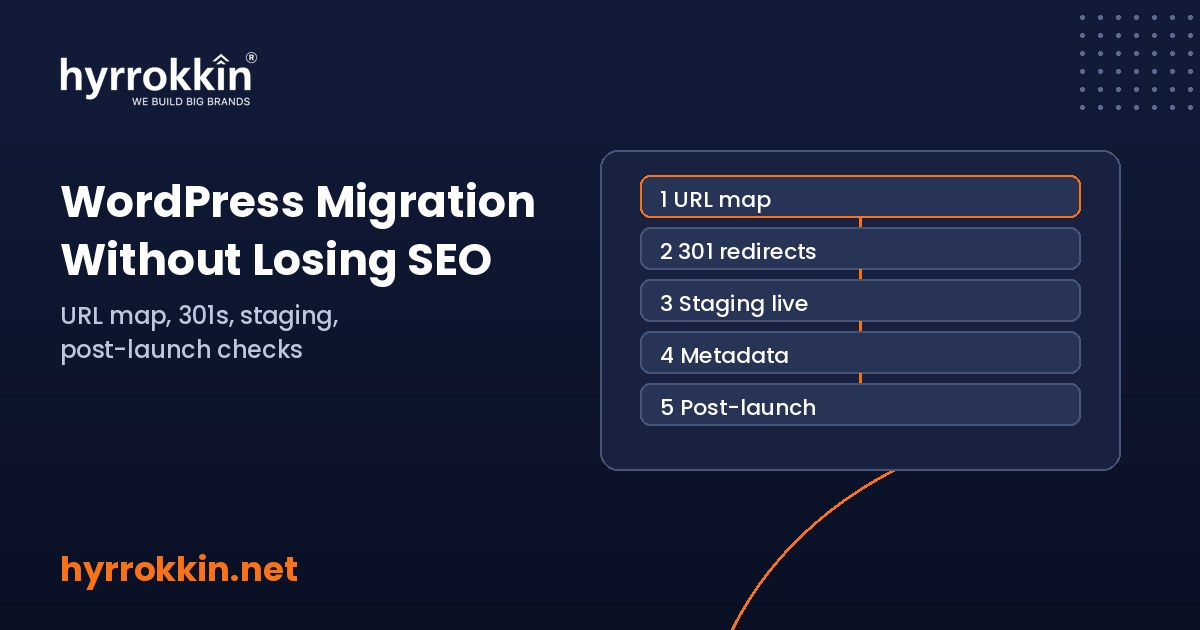
Before talking about colours and layouts, we agree the migration process. These are the five steps that protect your existing search presence.
1. Build a complete URL map
We crawl the existing site and list every live URL: pages, blog posts, product or service pages, PDFs and important images. Each old URL is matched to its new destination. Pages with no future are noted too, with a decision on where their visitors should go.
This map is the single most important document in the project. It also forces a useful conversation about content: what to keep, what to merge and what to retire.
2. Plan and implement 301 redirects
Every old URL that changes gets a permanent 301 redirect to the most relevant new page. Not to the homepage by default, but to the page that best answers the same need. We avoid redirect chains and test the full list before and after launch.
3. Build on staging while the live site keeps working
The new WordPress site is built on a separate staging environment. Your current website stays live, keeps taking enquiries and keeps its rankings while we work. Staging is protected from search engines so duplicate content does not leak into Google before launch.
4. Carry over metadata and internal links
For each important page we carry over or improve the page title, meta description, headings and key content. Internal links are updated to point directly at the new URLs. Canonical tags, structured content and image alt text are reviewed so nothing valuable is left behind.
5. Verify after launch
Going live is not the finish line. After launch we check:
- That indexing is enabled and the XML sitemap is submitted.
- That redirects work across the full URL map.
- That forms, call buttons, WhatsApp links and thank you pages work end to end.
- That analytics and conversion tracking are firing.
- That Google Search Console shows no unexpected spike in errors.
Issues found in this window are fixed quickly, while they are still small.
What is in scope in a proper WordPress migration
One reason quotes vary so widely is that “migration” means different things to different vendors. A cheap theme swap and a full managed migration are not the same service. A complete scope usually covers:
- Discovery and audit of the current site, content, URLs and integrations.
- Content classification: keep, update, merge or retire.
- URL mapping and redirect plan.
- WordPress build on staging, with a theme or design suited to your brand.
- Content migration, including metadata, images and alt text.
- Forms, CRM and tracking reconnection, so leads keep flowing.
- Security setup, including hardened admin access, updates and backups.
- Speed and mobile checks before launch.
- Go live and post launch verification.
- Handover and training, so your team can update pages without a developer.
If a quote does not mention redirects, staging or post launch checks, ask why. Those are the parts that protect your existing visibility.
What we will not promise
No honest agency can guarantee rankings or traffic after a migration. Search engines make their own decisions, and competitor activity changes over time. What we can commit to is a careful process that removes the avoidable risks: lost URLs, missing metadata, broken links and dead forms.
Be cautious of any proposal that promises a specific ranking or traffic number as part of a rebuild.
Pricing and timelines for Indian businesses
Every website is different in size, content and integrations, so we quote after an assessment rather than from a fixed menu.
As a guide, WordPress migration and modernisation projects in India typically start from INR 50,000+. The exact quote depends on the number of pages, the content to be moved, integrations and design needs. GST is additional. That figure is an entry level starting point only. Larger, more complex corporate sites are scoped and priced separately based on their own requirements.
Once scope is agreed, a typical migration takes around 2 to 3 weeks, depending on content readiness and approvals.
After launch, many clients choose ongoing care so the new site stays updated, backed up and secure. You can read about that on our website maintenance and secure AMC page.
Why businesses choose Hyrrokkin for website modernisation
- 500+ projects delivered across industries since we were founded in India in 2018.
- India and UAE presence: founded in India in 2018, UAE operations from 2025, with an office in Ajman.
- ISO/IEC 27001:2022 certified for information security management (Certificate Number 305024093029IS, issued by QRO, valid until 29 September 2027, second surveillance audit completed; certificate address in Thoothukudi, with our headquarters in Coimbatore).
- Process first approach: URL map, redirects, staging while live and post launch verification on every migration.
Organisations we have worked with on their websites include RINAC, T&I Global and Choose & Read. Each project was scoped individually to its own size and requirements.
Questions to ask any migration agency
Before you approve a quote, ask:
- Will you give us a full URL map and redirect plan before launch?
- Will the new site be built on staging while our current site stays live?
- How will page titles, meta descriptions and internal links be carried over?
- Who checks forms, tracking and Search Console after launch, and for how long?
- What exactly is excluded from the quote?
Clear answers to these tell you whether you are buying a careful migration or a theme swap.
Frequently asked questions
Will we lose our Google rankings when we move to WordPress?
A migration always carries some risk, and nobody can guarantee rankings. A proper URL map, 301 redirects, metadata carry over and post launch checks remove the most common causes of lost visibility.
Can our current website stay live during the project?
Yes. We build on a staging environment and switch over only after testing, so your current site keeps working and taking enquiries.
Do you migrate blog posts and old content?
Yes, as part of content classification. We agree what to keep, update, merge or retire, and every moved page keeps a redirect from its old address.
What happens after launch?
We verify redirects, forms, tracking and indexing after go live. For ongoing updates, backups and security, see our website maintenance and secure AMC option.
Get a free migration assessment
If your website is overdue for a move to WordPress but you cannot afford to lose the visibility and enquiries it already brings, start with an assessment. We will review your current site, URLs and integrations, then share a clear scope and quote.
Request your website modernisation assessment through the form or WhatsApp on our website modernisation page.