If your business is already protected by cybersecurity, do you really need AI security too?
At first, it may seem like an unnecessary distinction. After all, AI is another technology, and technology already falls under the broader umbrella of cybersecurity.
But AI is changing the way businesses build applications, handle information, automate processes, and interact with customers. An AI system may not simply store or process data—it can interpret instructions, generate responses, access business information, connect with APIs, and increasingly take actions on behalf of users.
That creates a different kind of security challenge.
Traditional cybersecurity still needs to protect your applications, networks, APIs, cloud infrastructure, identities, and data. But businesses adopting AI also need to consider what their AI systems can access, how they respond to instructions, and whether they can be manipulated into doing something they shouldn’t.
This is where the difference between AI security and cybersecurity becomes important.
AI security isn’t replacing cybersecurity. It’s becoming another layer businesses need to consider as AI becomes part of everyday operations.
What Exactly Is Cybersecurity?
Cybersecurity is the broader practice of protecting an organization’s digital environment from unauthorized access, attacks, disruption, misuse, and data loss.
It covers everything from websites and mobile applications to APIs, cloud infrastructure, networks, databases, devices, user accounts, and sensitive business information.
A business may already have vulnerability assessments, penetration testing, access controls, secure coding practices, cloud security measures, monitoring, and other security controls in place. These remain essential even when AI is introduced.
Consider a business using an AI-powered customer service application. The AI itself might be functioning exactly as intended, but if the API connecting it to the customer database has a vulnerability, an attacker could exploit that weakness without ever attacking the AI model.
That is why AI security cannot be separated from cybersecurity.
So, What Is AI Security?
AI security focuses on the risks that arise specifically from artificial intelligence. An AI application can process information, interpret natural-language instructions, retrieve data, interact with APIs, and, in some cases, perform actions automatically. The more capabilities it has, the more important it becomes to understand exactly what it can access and what it is allowed to do.
For example, imagine an AI assistant connected to a company’s internal systems. An employee might ask it to retrieve a report or summarize customer information. But what happens if someone manages to manipulate the AI into ignoring its intended instructions or revealing information they shouldn’t be able to access?
That is an AI security concern.
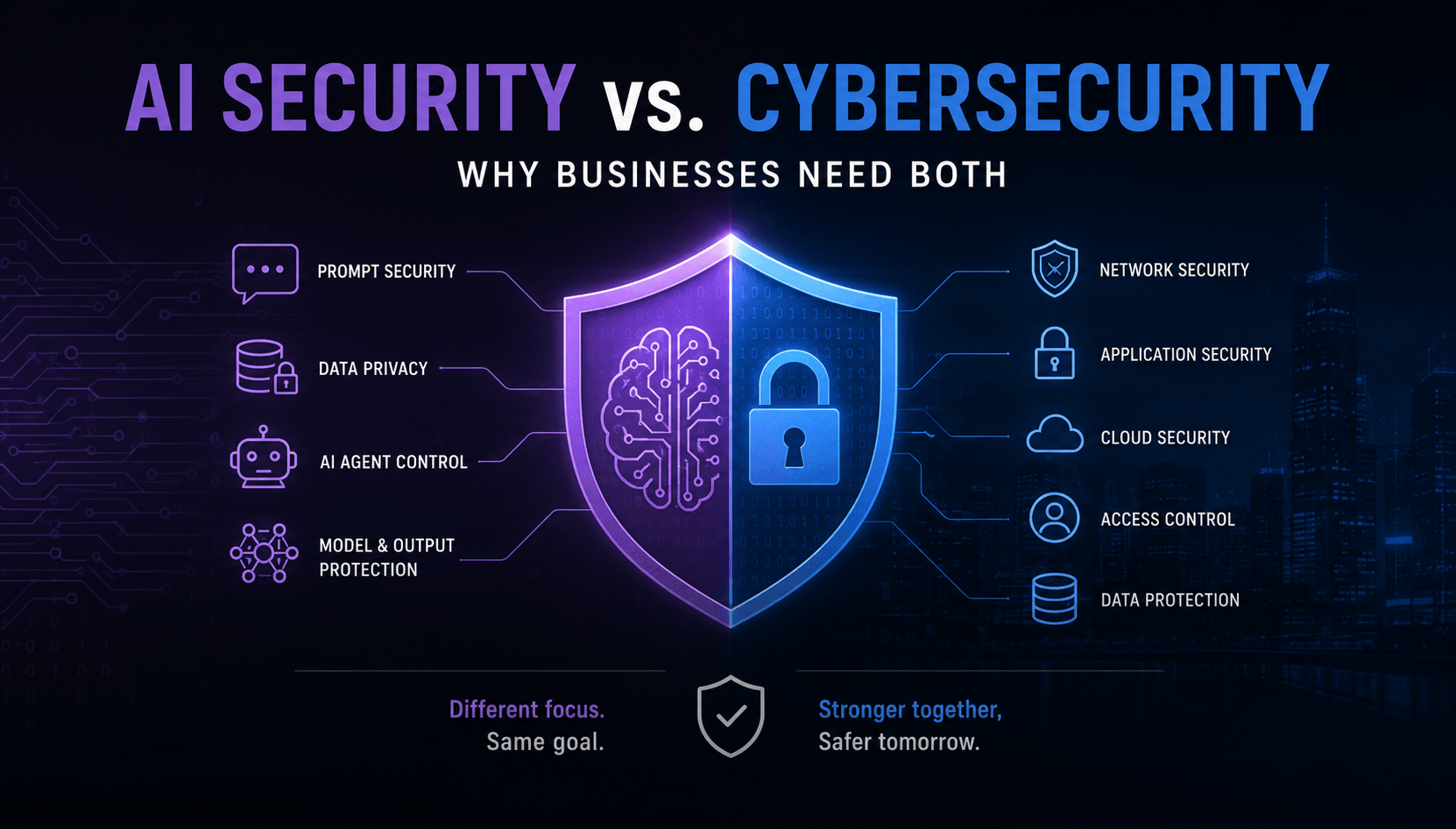
The difference can be understood simply: cybersecurity protects the wider digital environment, while AI security addresses the additional risks introduced by AI within that environment.
Why Does AI Introduce New Security Risks?
AI systems don’t always behave like traditional software, and that creates new areas for attackers to explore.
One example is prompt injection, where carefully crafted instructions can attempt to manipulate an AI system into ignoring its intended behaviour, revealing information, or performing an unauthorized action.
Then there is sensitive data exposure. Employees may enter confidential business information, customer details, intellectual property, or other sensitive data into AI tools without fully understanding how that information is handled.
Excessive permissions create another concern. If an AI agent has access to databases, financial information, administrative functions, or internal applications that it doesn’t actually need, a compromised or misused AI system could have a much larger impact.
AI applications also depend heavily on APIs and integrations. They may connect to databases, cloud services, CRMs, payment systems, and other applications. A weakness in any of those connections can potentially become a weakness in the overall system.
And then there is AI-generated code.
AI coding tools can help developers build software considerably faster, but speed doesn’t automatically equal security. Generated code can still contain vulnerabilities, insecure dependencies, weak authentication logic, or improper data handling.
AI can accelerate development. Security testing still determines whether what was built is safe.
Does AI Security Make Traditional Cybersecurity Less Important?
Quite the opposite.
The introduction of AI makes the fundamentals of cybersecurity even more important because an AI system is rarely operating on its own.
A business might build a secure AI application, but if the API connecting it to the backend is vulnerable, attackers can target the API instead.
This is why businesses still need strong application security, API security, identity and access management, cloud security, secure development, VAPT, and data protection alongside AI-specific security measures.
For example, VAPT can help identify vulnerabilities across the application and infrastructure supporting an AI solution. API security can help protect the communication between the AI and other systems. Access controls can ensure that the AI only has the permissions it actually needs.
The AI layer may be new, but the security foundation underneath it still matters.
Security Needs to Start Before the AI Goes Live
One of the biggest mistakes businesses can make is treating AI security as something to address after deployment. By that point, the AI may already be connected to internal systems, customer information, APIs, or business processes. Security needs to be considered much earlier.
When developing or integrating an AI-powered solution, businesses should understand what information the AI can access, who can use it, what actions it can perform, which systems it can connect to, and where human approval should remain necessary. This is security by design for the AI era.
The goal isn’t to make AI difficult to use. It is to make sure businesses can benefit from AI without creating unnecessary security gaps.
What Does ISO 27001 Have to Do With AI Security?
AI adoption also brings information security governance into the picture.
Organizations implementing ISO 27001 already have a structured approach to identifying and managing information security risks, controlling access, protecting information, managing incidents, and establishing security policies.
These principles can provide a strong foundation for managing AI-related risks as well.
Rather than treating AI security as an isolated technology project, businesses can incorporate AI-related risks into their broader information security and risk management strategy.
This becomes particularly important as AI moves from experimental tools to systems that handle real business data and perform real business functions.
AI Security and Cybersecurity Should Work Together
So, should businesses choose AI security or cybersecurity? The answer is simple: they need both.
AI is changing how businesses develop software, interact with customers, analyze information, and automate everyday operations. As those capabilities expand, so does the attack surface around them.
A business could have a secure AI model but an insecure API. It could have strong application security but give an AI agent excessive permissions. It could have a robust cybersecurity strategy but allow employees to enter sensitive information into unmanaged AI tools.
The security gap can appear wherever these technologies meet.
That is why AI security should not be viewed as a replacement for cybersecurity. It should be treated as an extension of it.
Cybersecurity protects the digital foundation. AI security protects the AI layer built on top of it.
Together, they give businesses a more complete approach to securing the technology they are increasingly relying on.
Building AI? Don’t Forget Security.
AI can make businesses faster, smarter, and more efficient. But that transformation shouldn’t come at the cost of security.
Whether you’re developing an AI-powered application, integrating AI into an existing platform, or introducing AI tools across your organization, security needs to be considered from the very beginning.
At Hyrrokkin, our cybersecurity expertise across VAPT, web application security, API security, cloud security, secure development, and information security consulting helps businesses strengthen their digital environments as technology continues to evolve. Because adopting AI is only part of the transformation.
The real advantage comes from adopting it securely.