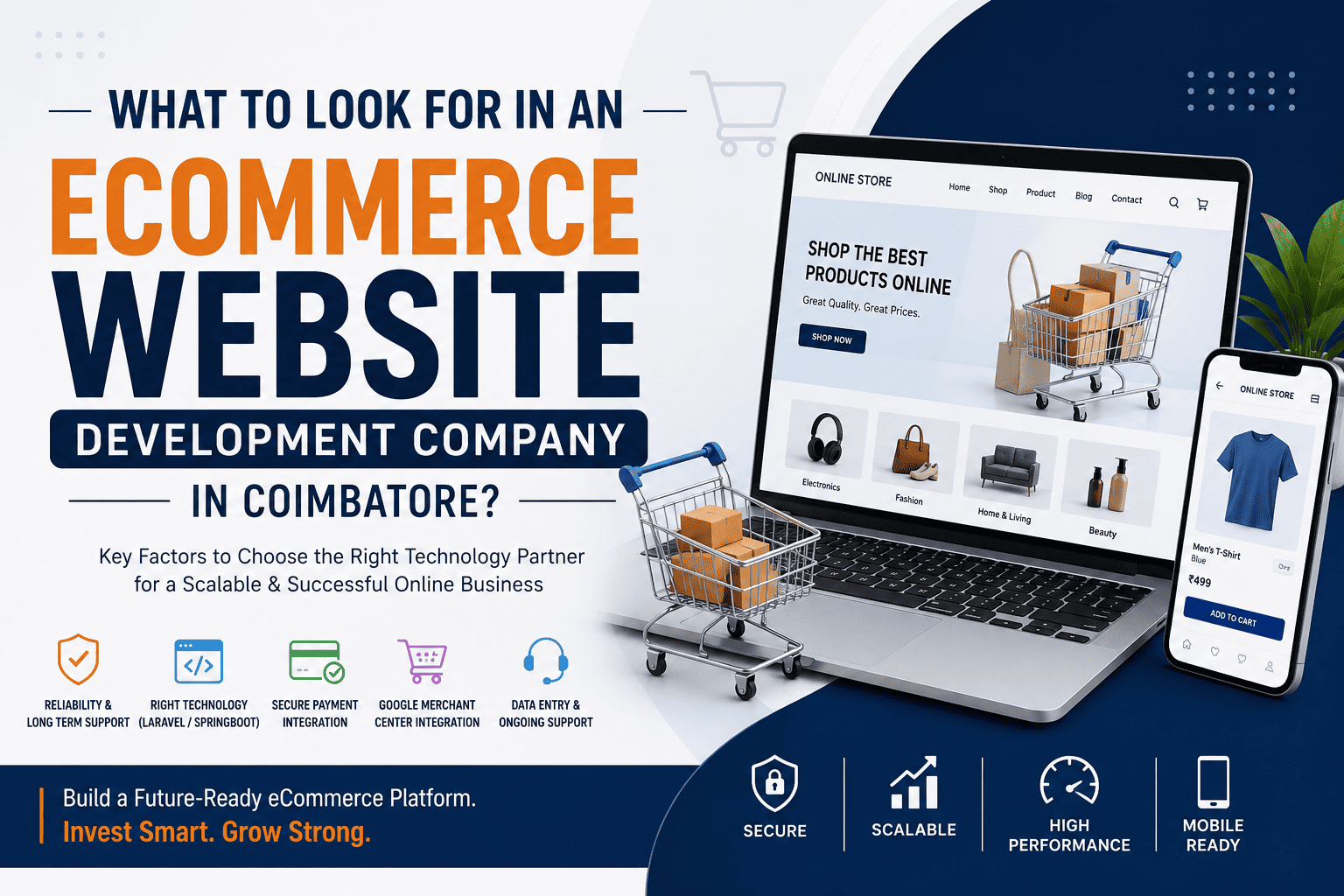
What to Look for in an eCommerce Website Development Company in Coimbatore?
The eCommerce industry in India is growing rapidly, and businesses are increasingly investing in online stores to expand their reach and improve sales. However, selecting the right eCommerce website development company is one of the most important decisions a business owner can make.
While many development companies promise low-cost solutions and quick delivery, not all of them can support your business as it grows. Before investing in an eCommerce platform, here are the critical factors you should evaluate.
1. Check Long-Term Reliability, Not Just Pricing
One of the biggest mistakes businesses make is selecting a development company based solely on price.
In our experience, nearly 3 out of 5 eCommerce development companies are either unavailable, unresponsive, or no longer operating when customers need technical support, upgrades, or bug fixes.
Before selecting a vendor, ask:
- How long has the company been in business?
- Do they have a dedicated support team?
- Can they provide maintenance contracts?
- Do they have long-term clients who can provide references?
- What happens if the original developer leaves the company?
Remember: An eCommerce website is not a one-time project. It requires continuous maintenance, security updates, feature enhancements, and performance optimization.
Choosing a reliable technology partner is often more valuable than choosing the lowest quote.
2. Understand the Technology Before Investing
Many business owners are told that WooCommerce or WordPress is the best option for eCommerce because it is affordable and quick to launch.
While WooCommerce can be suitable for small businesses with limited requirements, it is important to understand its limitations.
WooCommerce and WordPress
Advantages:
- Lower initial investment
- Faster deployment
- Large plugin ecosystem
- Suitable for startups and small product catalogs
Typical Cost:
- INR 30,000 to INR 1,00,000
However, WooCommerce is fundamentally a plugin-based solution built on top of WordPress.
As your business grows, you may require:
- Custom pricing models
- Vendor management
- Warehouse integrations
- ERP integration
- Loyalty programs
- Subscription billing
- Advanced shipping rules
- Marketplace functionality
Most of these requirements are achieved through additional plugins.
Over time, excessive plugin dependency can result in:
- Reduced website performance
- Increased security vulnerabilities
- Plugin compatibility conflicts
- Higher maintenance complexity
- Slower user experience
If your goal is to build a serious eCommerce business, avoid investing heavily in a plugin-dependent architecture.
3. Prefer Enterprise-Level Technologies for Scalability
For businesses expecting long-term growth, enterprise-grade frameworks offer significantly better flexibility and control.
Recommended Technologies:
Laravel
Laravel is one of the most popular PHP frameworks used for enterprise application development.
Benefits:
- Highly customizable
- Strong security architecture
- Easy third-party integrations
- Better performance optimization
- Easier future enhancements
Spring Boot
Spring Boot is a Java-based enterprise framework widely used by large organizations worldwide.
Benefits:
- High scalability
- Enterprise-grade security
- Excellent performance
- Suitable for complex business workflows
- Long-term maintainability
These technologies allow developers to build features according to your business requirements rather than forcing your business to adapt to a plugin ecosystem.
Expected Investment
A professionally developed eCommerce platform using Laravel or Spring Boot typically ranges between:
INR 4,00,000 to INR 25,00,000
depending on:
- Number of features
- Mobile application requirements for user, warehouse, seller etc
- ERP integrations
- Warehouse management
- Multi-vendor capabilities
- AI and automation requirements
The investment is higher initially but provides significantly better long-term value.
4. Ensure Data Entry Support Is Available
Many business owners underestimate the effort required to upload products.
A successful eCommerce store requires:
- Product images
- Product descriptions
- Technical specifications
- SEO metadata
- Pricing information
- Inventory details
- Category management
Ask the development company:
- Will they assist with product uploads?
- How many products are included?
- Do they provide image optimization?
- Do they provide SEO-friendly product content?
Data entry support can save hundreds of hours during launch.
5. Choose a Reliable Payment Gateway
Payment failures directly impact revenue.
Your development partner should recommend reputable payment gateways with strong uptime and security standards.
Recommended options:
Razorpay
Suitable for:
- Indian businesses
- UPI
- Credit cards
- Net banking
- Subscription payments
PhonePe Payment Gateway
Suitable for:
- Indian transactions
- UPI-heavy customer bases
- Fast settlements
Stripe
Highly recommended if:
- You sell internationally
- You accept foreign currencies
- You serve customers in multiple countries
Always ask about:
- Transaction charges
- Settlement timelines
- Refund handling
- Recurring billing support
- International payment capabilities
6. Google Merchant Center Integration Is a Must
Many businesses focus only on website development and forget product discoverability.
A modern eCommerce platform should integrate with Google Merchant Center.
Benefits include:
- Product visibility on Google Shopping
- Free product listings
- Better organic reach
- Improved shopping ad performance
- Higher conversion opportunities
Your development company should be capable of integrating:
- Google Merchant Center API
- Product Feed Automation
- Google Ads Conversion Tracking
- Enhanced eCommerce Analytics
Without this integration, you may miss significant sales opportunities from Google.
7. Verify Security Standards
An eCommerce platform stores valuable customer and transaction data.
Ask your development company:
- Do they follow secure coding practices?
- Is data encrypted?
- Is the website protected against SQL Injection?
- Is protection available against Cross-Site Scripting (XSS)?
- Are security audits performed?
- Do they provide SSL implementation?
Security should never be treated as an optional feature.
8. Check Mobile Responsiveness and App Readiness
More than half of online purchases now happen through mobile devices.
Your eCommerce platform should provide:
- Mobile-responsive design
- Fast loading speed
- Optimized checkout process
- Progressive Web App (PWA) capabilities
- Android and iOS application support
Ask whether the platform can easily support future mobile app development.
9. Understand SEO Capabilities
A beautiful website is ineffective if customers cannot find it.
Ensure the platform supports:
- SEO-friendly URLs
- Meta titles and descriptions
- Product schema markup
- XML sitemaps
- Canonical URLs
- Image optimization
- Page speed optimization
SEO should be built into the architecture from day one.
10. Ask About Future Integrations
As your business grows, you may need integrations with:
- ERP Systems
- CRM Platforms
- Accounting Software
- Shipping Aggregators
- WhatsApp Business API
- Marketing Automation Tools
- Inventory Management Systems
The development company should design the platform with future integrations in mind.
Final Thoughts
Choosing an eCommerce website development company is not simply about finding the lowest quotation. It is about selecting a technology partner capable of supporting your business for years to come.
Before signing any agreement, ask the following questions:
✓ How reliable is the company?
✓ What technology stack are they recommending?
✓ Is the platform scalable?
✓ Can they provide data entry support?
✓ Which payment gateways do they support?
✓ Do they integrate with Google Merchant Center?
✓ How secure is the platform?
✓ Is it SEO-friendly?
✓ Can it support future mobile apps and integrations?
A well-planned eCommerce platform can become one of the most valuable assets of your business. Investing in the right technology and the right development partner today can save significant costs and challenges in the future.